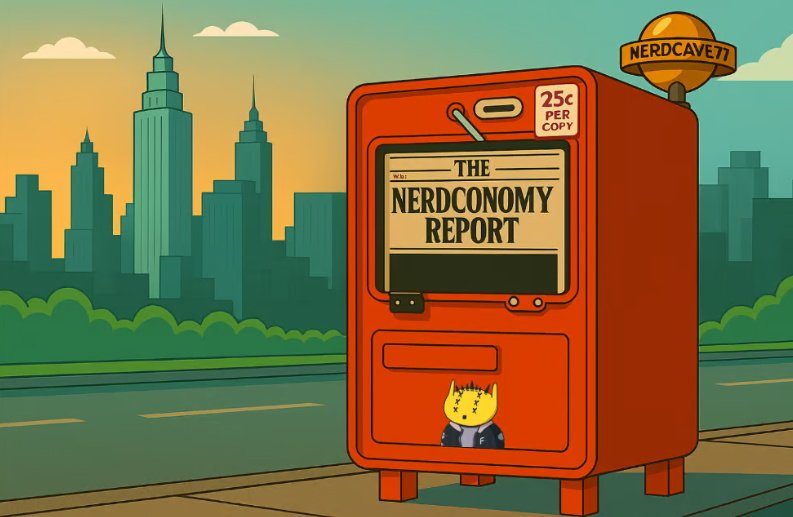
The Nerdconomy Report
10 Stories Shaping the Collectibles Market Right Now

Ceelow G
September 05, 2026
Sponsored by

Smarter CRM. Less Busywork.

Disconnected data and tools make it harder to understand your customers. HubSpot's Agentic Customer Platform brings your data, teams, and tech stack together with AI built in to help your business work faster and create more personalized customer experiences.
Why HubSpot and what's new
Use AI powered tools to take action faster
Unify your data, teams, and tech stack in one place
Create one shared view of customer data
Connect teams around the same customer context
Bring your business tools into one place
Connect more of your business in one place and give every team a smarter way to work. Get set up quickly and start checking off your hardest tasks.
10 Stories Shaping the Collectibles Market Right Now
From a $62.9 million sports auction to Solana arriving on OpenSea, million-dollar Pokémon cards, tokenized luxury goods and VeVe's potential Nasdaq future.. the collectibles world had a lot to talk about over the past two weeks.
The past two weeks gave us a little bit of everything.
Here are ten stories we think collectors should have on their radar.
Heritage Auctions Has a $62.96 Million Weekend
Heritage Auctions' Summer Platinum Night sports auction generated $62.96 million and reportedly set more than 200 individual auction records.
A T206 Piedmont Honus Wagner sold for $5.856 million, a 1952 Topps Mickey Mantle PSA 8 reached $3.721 million, and Diego Maradona's match ball from the 1986 World Cup sold for $3.355 million.
Other seven-figure results included a 1933 Goudey Babe Ruth, a Sandy Koufax jersey and a signed Michael Jordan Fleer rookie buyback.
The bigger takeaway is that serious money is still flowing toward collectibles that combine scarcity, history, condition and provenance.
Solana NFTs Have Arrived on OpenSea
OpenSea added full support for Solana NFTs on August 31, allowing Solana collections to sit alongside collectibles from more than 25 other blockchains.
Collections such as Claynosaurz and Mad Lads are part of the expansion, and Candy Digital was also involved as a launch partner as its collectibles continue transitioning toward Solana.
This matters because it helps reduce one of digital collecting's biggest problems: fragmentation between ecosystems.
The closer digital collecting gets to a world where collectors can move and trade assets without worrying about which blockchain they came from, the better the experience becomes.
Topps Is Turning Champions League Debuts Into 1-of-1 Cards
Beginning with the 2026/27 UEFA Champions League season, players making their first Champions League appearance will wear a special sleeve element.
After the match, the blue component will be removed and authenticated before Topps incorporates it into a signed one-of-one trading card.
Instead of simply manufacturing scarcity with a 1/1 stamp, the card contains something directly tied to an actual historical moment.
For a future superstar, that could become an incredible piece of sports history.
This is a good example of modern cards shifting toward scarcity plus provenance, rather than scarcity alone.
Another Pikachu Joins the Million-Dollar Club
CGC reported that a 1996 Japanese CoroCoro Comics Pikachu Glossy "Incorrect Illustrator" sold privately for $1.3 million.
The card was graded CGC Gem Mint 10, and CGC said it became one of the highest-value cards it has ever certified.
The significance goes beyond one sale.
Pokémon now has enough history for collectors to distinguish between early releases, rare variants, distribution methods, condition and population.
The top of the Pokémon market is increasingly behaving like a mature trophy collectibles market.
What If Your Watch Could Be Traded Without Ever Leaving the Vault?
Beezie and The Luxury Closet are preparing to create tokenized digital twins of authenticated physical luxury collectibles, including watches, handbags, jewelry and accessories.
The concept would allow the physical collectible to remain stored while its digital representation is bought and sold.
If the owner eventually wants the physical item, the digital asset can be redeemed and the collectible delivered.
That could reduce repeated shipping, insurance and authentication every time an expensive collectible changes hands.
There are still important questions around custody, redemption and trust, but this is one of the more practical examples of blockchain technology being used to improve physical collecting rather than replace it.
AI Is Coming for Collectibles Research Too
OpenSea integrated its marketplace data with Perplexity Computer, providing access to NFT, token and collectible data across more than 25 networks.
The idea is to allow collectors to ask natural-language questions instead of manually digging through multiple marketplaces and analytics tools.
Imagine being able to ask which collections gained the most buyers this week, which assets had the biggest sales, or where volume is moving without bouncing between different platforms.
AI doesn't make a collectible valuable, but it could dramatically reduce the friction involved in researching and understanding collectible markets.
NFT.NYC Returns for Year Nine
NFT.NYC returned to Times Square from September 1–3 for its ninth annual edition, with organizers advertising 12 industry tracks along with onchain art programming.
The NFT market clearly isn't operating with the same speculative energy it had in 2021 and 2022.
But artists, marketplaces, developers and collectors are still building.
That may actually be healthier.
The conversation is slowly moving away from pure speculation and toward what digital ownership and blockchain technology can actually do for collecting.
Digital Art Continues Finding Its Way Into Museums
Recent programming at the Museum of Art + Light highlighted AI-collaborative digital artwork involving Stern/Stiles.
There wasn't a huge sale attached to the story, but digital art needs more than floor prices if it wants to mature.
It needs museums, curators, grants, collectors and historical documentation.
Institutional recognition matters because it helps separate digital art from the purely speculative side of the NFT market.
Long-term cultural relevance will ultimately depend on whether people still care about the work years from now.
Candy Digital and DC Are Parting Ways
Candy Digital told its community during a recent team stream that its licensing relationship with DC is coming to an end.
That means collectors should not expect future DC drops under the current relationship.
Existing Candy collectibles are not simply disappearing, however.
Candy has been moving its collectibles toward Solana and self-custody, and eligible collectibles can be held directly by collectors rather than remaining completely dependent on Candy's platform.
Candy's involvement with OpenSea's Solana rollout also gives those assets access to a broader marketplace.
This is why the ownership conversation matters.
Licensing agreements can end. Companies can change direction. Platforms can close.
Owning a digital collectible should ideally mean being able to hold it, transfer it, give it away and sell it, even when the business relationship behind the original release changes.
Collectors aren't buying Batman or Superman's intellectual property, but ownership of the collectible itself should still carry meaningful rights.
VeVe Takes a Major Step Toward Wall Street
ORANGEKLOUD Technology announced a definitive agreement to acquire Orbis Technology Limited, the operator behind VeVe.
If the deal closes, ORANGEKLOUD would be renamed VeVe Inc., and the company intends to trade on Nasdaq under the ticker VEVE.
The transaction also contemplates a private placement of between $30 million and $100 million.
The deal has not closed yet and remains subject to shareholder approval, financing, Nasdaq approval and other conditions.
So VeVe is not publicly traded yet.
But a definitive acquisition agreement makes this much more than just an idea.
If completed, one of the biggest licensed digital collectible platforms would suddenly face an entirely different level of public visibility, scrutiny and expectations.
Collectors will be watching closely to see what this means for licenses, future drops, OMI and especially the health of VeVe's secondary market.
The Bigger Picture
Physical collectibles are still producing some of the biggest hard-dollar sales in the market.
Digital collecting, meanwhile, is increasingly focused on interoperability, self-custody, tokenization, data infrastructure and provenance.
Topps is connecting physical collectibles directly to historic sporting moments. Beezie is experimenting with digital ownership of authenticated physical goods. Candy's DC situation shows why transferability and self-custody matter. OpenSea is reducing barriers between blockchain ecosystems. VeVe could be entering an entirely new chapter as a potentially publicly traded company.
Across all of these stories, the same themes keep appearing:
Scarcity. Ownership. Provenance. Authenticity. History.
Maybe the future isn't physical collectibles versus digital collectibles.
Maybe it's just collecting.
And the definition of what we can collect is getting bigger.
Nerdcave’77