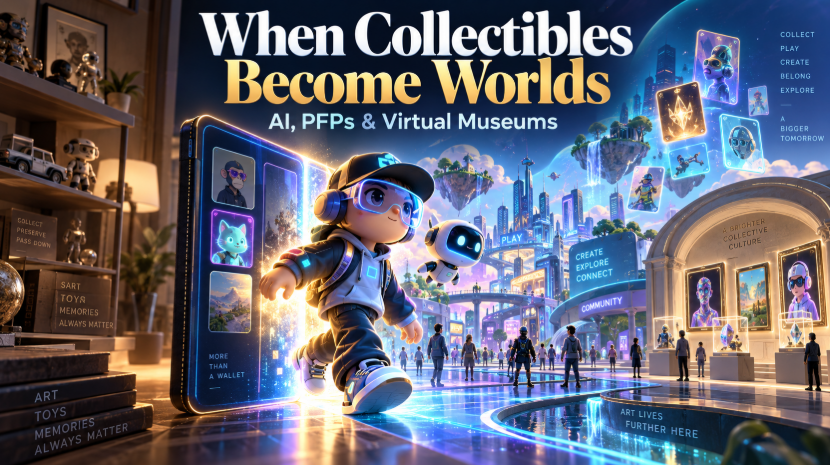
When Collectibles Become Worlds
From PFPs to Metaverses: What AI Could Unlock for Digital Collectibles

Ceelow G
September 06, 2026
Sponsored by

Unify Your Teams and Tech Stack With HubSpot

Connect your customer data, teams, and tools without the hassle of complex integrations or lengthy setups. One easy platform gives marketing, sales, and service teams a unified customer view and the tools to turn it into growth.
Why HubSpot and what's new
• Generate leads and automate marketing with Marketing Hub
• Build your pipeline and close more deals with Sales Hub
• Scale customer support and drive retention with Service Hub
• Keep customer data clean, connected, and actionable with one, unified platform
Join 306,000+ in over 135 countries using HubSpot to grow their businesses.
See what a more connected approach to growth can do for you and your team. Get setup quickly and start checking off your hardest tasks.
AI could turn digital collectibles from things we simply own into characters, games, museums, and entire experiences we can actually build around.
For years, one of the biggest promises surrounding digital collectibles was that they could eventually become more than images sitting in a wallet.
We heard about utility. Games. Metaverses. Interoperability. Digital identity. Virtual worlds.
Some of those ideas became real. A lot of them never made it past the roadmap.
The problem was never necessarily a lack of imagination. It was that building those experiences was expensive and complicated. Creating a game or interactive world traditionally required developers, designers, artists, 3D modelers, servers, game engines, and a lot of time.
That is where the newest generation of AI tools starts to become very interesting.
What caught my attention about AI systems like Astra isn't simply that they can help write code. It is how quickly the distance between having an idea and building something people can actually interact with appears to be shrinking.
And as someone who collects digital assets, my mind immediately went somewhere else.
What could this mean for the characters, PFPs, artwork, and IP already sitting in our wallets?
Maybe the PFP was only the beginning
Think about how most of us use a PFP today.
We buy one we connect with. We use it as our profile picture. We join the community. Maybe we collect more from the project, buy merchandise, attend events, or simply enjoy being associated with the brand.
But imagine taking that same character and telling an AI:
Build me a small game around it.
Make my PFP the playable character.
Use its traits to determine its abilities.
Create a town based on the artwork of the collection.
Turn rare traits into special weapons, vehicles, or locations.
Build a clubhouse where holders can meet.
Create a racing game where everyone enters using the collectible they actually own.
That starts to change the meaning of owning a digital character.
You are no longer simply collecting the finished product.
You may be collecting a building block.
And that is where digital collectibles begin separating themselves from physical collectibles in a very important way.
Digital can do something physical simply cannot
I love physical collectibles. That isn't changing.
A vintage Star Wars figure, an important comic, a rare sports card, or a signed piece of memorabilia has history, scarcity, and a physical presence that digital collectibles can't replace.
But digital collectibles have a completely different advantage.
They can interact with software.
A physical Batman figure can sit beautifully on your shelf.
A digital character can potentially become the character inside the experience itself.
Your wallet can prove ownership. The collectible's traits can become data. Certain assets could unlock locations, abilities, events, or experiences.
That kind of functionality is native to digital collecting.
And I think this matters because, for years, the digital collectible industry has tried to convince mainstream collectors to care about blockchain technology.
Maybe that was the wrong approach.
Most people don't care what blockchain your collectible lives on.
They care about what they can do with it.
If someone sees their friend entering a game as the PFP they actually own, that's understandable.
If owning a collectible unlocks a secret room inside a virtual world, that's understandable.
If your character's rare trait becomes a weapon or ability inside a game, that's understandable.
You don't need a twenty-minute explanation about Web3.
The experience explains the technology.
And that could become one of the things that finally drives more traditional collectors toward digital collecting.
Not because digital replaces physical.
Because digital can offer experiences physical objects simply can't.
Your collection could become a museum
Games aren't even the possibility that excites me the most.
Collectors love displaying what they own.
We build comic rooms. Card walls. Glass cases. Toy shelves. Entire rooms dedicated to Star Wars, Batman, Pokémon, sports memorabilia, and everything else we love.
Why wouldn't we eventually do the same thing digitally?
Imagine building your own virtual museum.
You walk through the front entrance and one room contains your digital comics.
Another room holds your PFP collection.
Another displays your sports collectibles.
Maybe your Star Wars pieces sit inside a giant space station.
Your Batman collection could be hidden inside a virtual cave beneath Gotham.
Your rarest collectible could sit in the center of a massive room under museum lighting.
Click on it and you see the edition size, mint number, ownership history, or maybe even the story of when and why you bought it.
And because the museum is digital, there are no physical limitations.
Your gallery doesn't need to fit inside your house.
It could be the size of a city.
That becomes especially interesting when we start talking about officially licensed digital collectibles.
Imagine visiting someone's virtual collection and seeing licensed characters and assets they actually collected displayed together like a private pop-culture museum.
Disney. Marvel. DC. Star Wars. Sports. Comics.
Potentially all living inside environments designed by the collector.
There are obviously licensing questions here. Owning a digital collectible does not automatically mean you own the commercial rights to Batman, Darth Vader, or any other licensed character. Every platform, brand, and Web3 project can grant different rights.
That distinction matters.
But where platforms and licenses allow personal display, interaction, or creation, AI could make those possibilities dramatically easier to explore.
Communities could build instead of waiting
This could also completely change the relationship between Web3 projects and their communities.
During the last NFT cycle, projects raised millions of dollars promising games and metaverses.
Building them took years.
Sometimes they were completed.
Sometimes they weren't.
AI could dramatically lower that barrier.
Instead of one development team being responsible for creating everything around a project, perhaps the community starts creating too.
One holder makes a racing game.
Another creates a virtual gallery.
Someone builds a fighting game.
Another holder creates a horror experience.
Someone else turns the characters into an interactive story.
All using the same underlying collection.
There doesn't necessarily have to be one official world anymore.
There could be hundreds.
And suddenly, giving holders meaningful creative or commercial rights becomes much more powerful because ordinary people may finally have the tools to actually use those rights.
Rights are only so valuable when creation requires a million-dollar development budget.
They become a lot more interesting when one creative person with an idea can start building.
Maybe this is the utility we were waiting for
For a long time, digital collectible utility was something projects promised to deliver later.
Buy today.
Utility tomorrow.
Maybe AI changes that relationship.
Instead of waiting for someone else to give our collectibles utility, perhaps collectors start creating it themselves.
That doesn't mean everyone will become a game developer.
It doesn't mean AI will magically produce the next Fortnite with one sentence.
Good experiences will still require creativity, judgment, testing, and probably plenty of technical knowledge.
But the barrier is moving.
And when the barrier to creation falls, more people create.
More strange ideas get tried.
More small communities build things specifically for themselves.
And digital ownership starts becoming easier to understand.
Maybe one day buying a PFP won't simply mean buying an image.
Maybe you're buying a character you can take into a game.
A piece of a larger world.
A key to a virtual space.
The centerpiece of your own digital museum.
Or simply the beginning of something nobody has thought of yet.
That is the part I find exciting.
AI isn't interesting to digital collecting simply because it can build games.
It's interesting because it might give millions of collectors the ability to turn “Wouldn't it be cool if…” into something other people can actually experience.
For years we kept asking:
What utility does this collectible have?
Maybe the better question moving forward is:
What can I build with it?