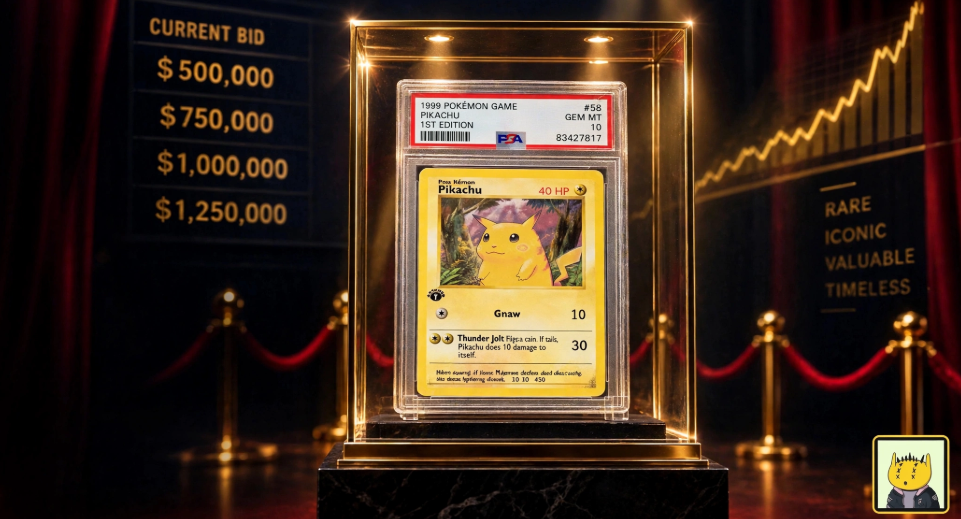
Pokémon Cards Are Becoming Mainstream Investments. But Is the Growth Healthy?

Ceelow G
September 16, 2026
In partnership with

The World's Best Choose IM8. Here's Why.

David Beckham. Giannis Antetokounmpo. Aryna Sabalenka. Inter Miami CF. The world's best choose IM8 because performance starts with what you do every day.
Daily Ultimate Essentials Pro delivers a complete, clinically formulated system for energy, digestion, sleep, focus and healthy aging. In a 12-week randomized controlled trial, 95% felt a boost in daily energy, 85% felt less bloated with better digestion, 80% reported better sleep and 75% reported sharper focus and mental clarity.
IM8 is NSF Certified for Sport, tested against 280+ banned substances and recommended by 300+ clinicians. With 50 million servings sold across 46 countries, discover the IM8 routine trusted at the highest levels of sport—and built for everyday life. See the clinical results.
Pokémon is no longer sitting quietly in the collectibles aisle. Record sales, professional dealers and wealthy buyers are pushing the hobby toward the financial mainstream. The opportunity is real, but so are the warning signs.*
For years, people outside the hobby looked at Pokémon cards as toys for children or nostalgic pieces of cardboard kept by adults who never stopped loving Pikachu and Charizard.
That view is becoming harder to defend.
The Financial Times, a publication better known for covering stocks, bonds and global markets, recently examined why Pokémon cards are selling for more than $1 million. Its report described professional dealers generating millions in sales, wealthy collectors entering the hobby and livestream transactions reaching tens of thousands of pounds.
When the financial press begins treating Pokémon like an alternative asset, the hobby has clearly entered a different stage.
The question is no longer whether Pokémon cards have value. The market has already answered that. The real question is whether the current growth is creating a stronger collectible market or building another speculative bubble.
The sale that changed the conversation
In February 2026, Logan Paul’s PSA 10 Pikachu Illustrator sold through Goldin for $16.5 million, setting the auction record for any trading card, not only Pokémon. Paul had acquired the card in 2021 for $5.275 million. According to the Associated Press, only a few dozen Pikachu Illustrator cards are believed to exist, and Paul’s copy is believed to be the only one graded PSA 10.
That sale matters because it placed Pokémon beside the most important sports cards, comic books, artwork and historical memorabilia in the world.
It was not simply an influencer selling a famous card. A trophy asset with elite rarity, the highest possible grade and a well-documented public history attracted eight figures in an open auction. That is the kind of transaction investors, auction houses and wealthy collectors notice.
The market did not stop with that one card. In August, a 1998 Japanese CoroCoro Pikachu Illustrator graded BGS 8.5 sold for $1,006,500 at Goldin. The enormous gap between that result and the PSA 10 record also shows how much grade, provenance and uniqueness matter at the top of the market.
Pokémon is not producing million-dollar sales because every old card is valuable. It is producing them because a very small group of cards combines powerful intellectual property with extreme, authenticated scarcity.
Scarcity is still the engine
The Pokémon market may look new to Wall Street, but the formula behind it is not new at all.
Collectors chase what is difficult to obtain.
Rolex protects demand by keeping desirable watches hard to find. Trading-card companies build excitement through short prints, rare parallels, serialized cards and one-of-ones. In both physical and digital collecting, the same cycle continues to work:
Drop. Chase. Pull. Share. Repeat.
Pokémon does this exceptionally well. A collector can buy an affordable pack and still feel connected to a market that includes seven-figure trophy cards. The possibility of finding something rare creates excitement, while the established history of the brand gives collectors confidence that people may still care about these characters decades from now.
But scarcity must be real.
A low population only matters when collectors want the item. A popular character only becomes investment-grade when supply, condition and demand work together. A card with thousands of perfect-grade copies cannot be evaluated the same way as a contest trophy card with only a few dozen known examples.
That difference is where many new buyers get into trouble.
Pokémon is investable. Not every Pokémon card is.
The record headlines create a dangerous illusion: if one Pikachu sold for $16.5 million, perhaps the sealed box at a local store or the newest Charizard pulled on a livestream is guaranteed to rise too.
It is not.
The strongest Pokémon assets usually share several qualities:
Genuine scarcity, supported by a small edition or grading population
Strong demand for the character, set or historical moment
Trusted authentication and condition grading
Clear provenance, especially for trophy and promotional cards
Enough market activity to establish believable prices
Most modern cards do not meet all five standards. Some may still perform well, especially rare chase cards, but buyers should not confuse temporary excitement with lasting scarcity.
Modern production can be large. Population reports can grow quickly as more cards are submitted for grading. A card that appears rare during release week may look much less special six months later.
The top of the Pokémon market may be maturing into an alternative-asset category while other parts of the market remain highly speculative. Both things can be true at the same time.
Signs of healthy growth
Several developments suggest the Pokémon boom is more than a short-lived trend.
First, the buyer base is expanding. Many millennials who grew up with Pokémon now have more disposable income and are returning to the hobby. Wealthy collectors who once focused on sports cards, watches or art are also beginning to compete for top Pokémon pieces.
Second, the market infrastructure is improving. Major auction houses now handle high-end Pokémon cards. PSA, CGC and Beckett provide grading and population data. Marketplaces publish completed sales, while conventions, card shops and livestream platforms give collectors more ways to buy and sell.
Third, the Pokémon brand has survived multiple generations. The franchise celebrated its 30th anniversary in 2026, and parents who grew up with the original games and cards are now introducing Pokémon to their children. That cross-generational demand gives the market something speculation alone cannot create: culture.
This does not guarantee that prices will rise forever. It does mean Pokémon has a deeper foundation than a collectible built around one temporary trend.
The warning signs are real
Healthy demand can still become overheated.
The biggest risk is that people stop buying cards because they love collecting and start buying only because they expect someone else to pay more later. Once every pack becomes a lottery ticket and every buyer expects an automatic profit, the hobby moves closer to speculation than collecting.
High prices also attract counterfeits, altered cards, theft and fraud. Authentication, insurance and secure storage become increasingly important when a collection is worth as much as a house or more.
Liquidity is another concern. A recent sale may establish a headline price, but it does not guarantee another buyer will appear at that price when an owner needs cash. A card can be rare and valuable while still taking weeks or months to sell. That makes it very different from a publicly traded stock.
Collectors also need to separate asking prices from completed sales. A card listed for $100,000 is not a $100,000 card until a real buyer completes the transaction. In a fast-moving market, verified sales matter more than screenshots and hype.
What digital collecting should learn from Pokémon
The Pokémon market offers a clear lesson for digital collectible platforms: collectors do not reject supply, but they need meaningful scarcity within that supply.
Pokémon can print products for a global audience while still creating trophy cards, short prints and chase pieces that give collectors something difficult to find. The mass-market product brings people in; scarcity keeps them hunting.
Digital collectibles can follow the same blueprint through limited editions, one-of-ones, low-mint chasers, transparent population data and blockchain-verified ownership. But scarcity cannot be added only as a marketing phrase. Collectors need to verify how many items exist, who owns them and whether more can be created later.
Physical Pokémon cards rely on grading and provenance. Digital collectibles rely on smart contracts and transparent ownership records. Different technology, same need: trust.
The Nerdcave77 verdict
Pokémon has crossed into the mainstream as a serious collectible asset class, but only at the right level of the market.
The $16.5 million Pikachu Illustrator was not proof that every Pokémon card is an investment. It was proof that the best Pokémon cards can compete with the best collectibles in the world.
That is an important distinction.
The market looks healthiest when collectors understand what creates value: authentic scarcity, strong demand, condition, provenance and enough liquidity to support real sales. It looks most dangerous when buyers assume the logo alone guarantees profit.
Pokémon is no longer just a childhood hobby. It is a global collectibles market with professional dealers, serious capital and museum-level trophy pieces. But the rules of collecting have not changed.
Buy what you understand. Verify the population. Study completed sales. Respect liquidity. And never forget that the most durable collectibles usually begin with something money cannot manufacture: people genuinely caring about the item.
That is why Pokémon has become an investment category.
It is also why the best Pokémon cards were collectible long before the financial world finally noticed.